Simplify Before You Automate
Don’t automate the mess. Simplify and standardize the work first, or technology will just help the clutter move faster.
5-minute read
Business has never been more complex, but making work even more complicated can’t be the answer.
Organizations are stretched thin, and people are expected to learn new tools, adapt to new demands, and keep up with growing complexity at a pace that no longer lets up. On top of that, the workforce is more fluid than ever, with people changing jobs more frequently. In today’s world, we consider an employee who stays for two years to have “staying power.” Everyone feels stressed, pressed, and short on capacity.
So, it’s no surprise that leaders look to automation for immediate relief. The promise of technology has conditioned companies to expect major gains in productivity and efficiency from new software, platforms, and cloud-based tools. Hoping technology will lead employees to do what they aren’t currently doing, managers and executives leap straight into automation. Mistakenly, they expect technology to create discipline, provide structure, or jump-start a stronger strategy.
Usually, it does none of those things.
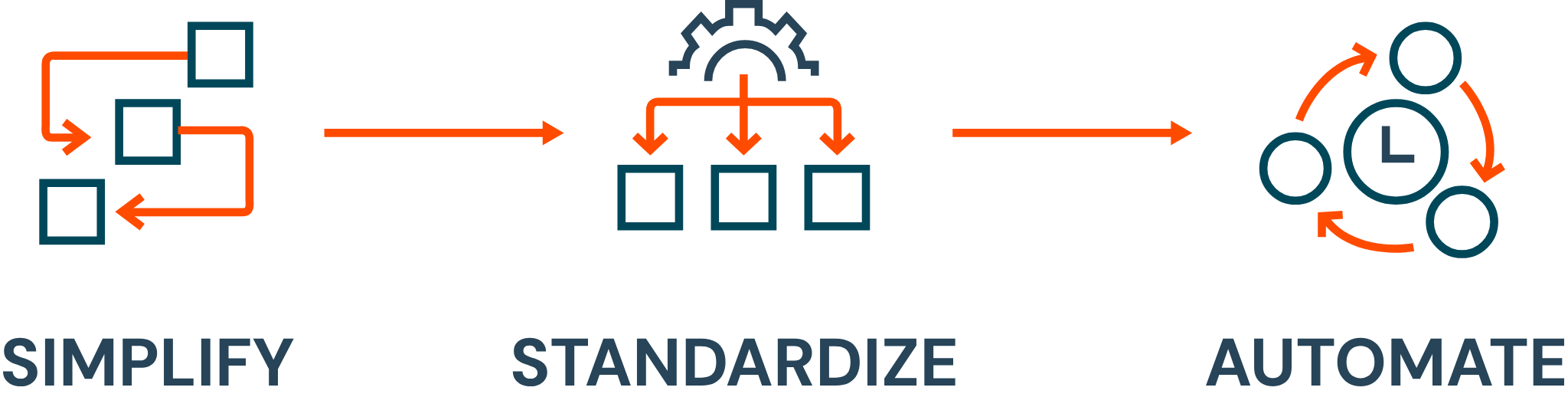
When you drop technology into a complex, inconsistent system, you don’t eliminate waste—you digitize it. In many cases, you add more activity and operational clutter. That’s why technology investments should follow a more disciplined sequence: simplify, standardize, automate (SSA).
One warehouse team bought scan guns to speed up inventory transactions before the underlying process was reliable. Employees were already making errors, so the technology didn’t solve the problem — it multiplied it. In the time it once took to generate one error manually, the team could now generate ten. That’s what happens when automation is applied before simplification and standardization. First, make the work reliable. Then make it faster.
Before applying technology, perfect your analog process.
Start by Simplifying
First, determine if the process you’re considering for a technological makeover is even worth simplifying. Is it essential or superfluous? Investing valuable resources into technology that automates a superfluous process compromises the health of your business.
To identify the value of a process or system, ask:
- What is the basic deliverable our customers want?
- What does our customer do with our deliverable?
- How can we give our customers what they want in the fewest steps possible?
Those questions force leaders back to the essence of the business. They clarify what truly matters and what has accumulated over time.
Then, before investing a dollar in technology, require the team to execute the process manually, without any technological assistance. That exercise brings clarity to outcomes, creates alignment on standards, and exposes dysfunction that software would otherwise hide. Analyze where the process is working well and where it isn’t.
Encourage the team to identify extra steps and edit the process down. Why? Simplified processes are more robust and less susceptible to technology challenges. Most teams discover they can eliminate more than they expected. And once the process is simplified, the amount of automation required often drops with it.
That matters, because the real goal of automation is not just speed. It’s greater reliability and less time required to complete the work. Applying technology to a simplified process usually improves both far more than applying it to a complicated one.
Then Standardize
Once you’ve articulated the essential processes for your business, the next step is standardization.
Assume your top performers will be the ones carrying out those processes. Technology investments are resource intensive, so there’s little sense in building them around the habits of your lowest-performing percentile. Use your top performers to define the best practices and make those practices standard.
Without identifiable standards, organizations tend to spend more on technology than they need to—and often on multiple technologies stacked one on top of the other. The goal of standardization is to increase the efficiency of producing the best possible outcome and make collaboration easier.
It’s impossible to automate when every person is doing the same work a different way.
Then Automate—Because Now It Matters More Than Ever
Only after the work is simplified and standardized should technology enter the picture. Today that step matters more than ever.
For many companies, automation—including robotic process automation (RPA) that automates information-intensive tasks—is no longer about being progressive or cutting-edge. It’s about survival. Persistent labor shortages in manufacturing are forcing leaders to do more with fewer people, and not just temporarily. It has become the status quo. That changes the automation conversation, making automation less discretionary and more necessary.
But that still doesn’t mean automate first.
If labor is tight, the stakes are actually higher. You can’t afford to automate waste. You can’t afford to spend heavily on tools that reinforce a bloated process. And you can’t afford to tie up your best people implementing technology that should never have been built around a messy workflow in the first place.

That’s why simplification matters so much now. It protects the investment. It ensures automation is solving a real problem instead of masking one.
Done well, automation should augment work and accelerate it. It should remove repetitive burden, improve consistency, speed the flow of information, and free people to do the higher-value work that still requires judgment, creativity, and problem-solving.
But automation only creates that kind of leverage when it is built on a simplified, standardized process. Otherwise, it just makes clutter move faster.
The companies that benefit most are the ones that simplify first. Will yours?